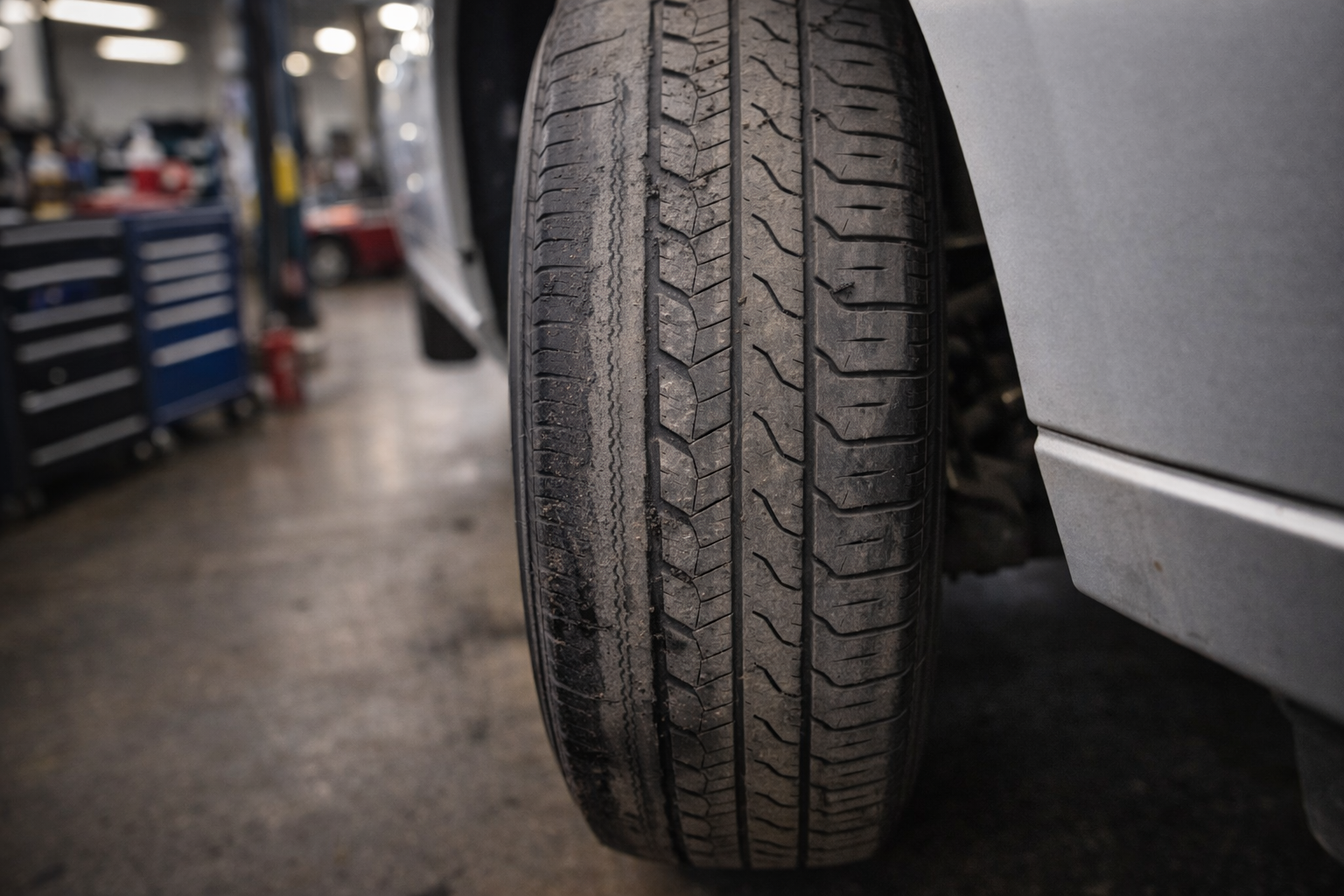
What Uneven Tire Wear Says About Your Brakes and Suspension
Your tires are the one part of your car that tells the whole truth. They absorb every pothole on Summer Ave, every hard stop on Poplar, every mile of I-240 commuting — and they record all of it in the tread. If the wear looks wrong, something upstream caused it. The tire is the symptom. The brake or suspension problem is the diagnosis.
At Snell Automotive, we've been reading Memphis tires for over 50 years. Here's how to interpret what yours are telling you.
Reading the Patterns
Wear on the inner or outer edge only — called camber wear — means the wheel is tilted relative to the road surface. This almost always points to a suspension problem: worn ball joints, a bent control arm, or alignment that's drifted out of spec. You'll notice the tire looks fine in the center but is chewed down to cord on one side.
Cupping or scalloping — a wavy, uneven pattern across the tread — is the signature of worn shocks or struts. When a shock can't control the wheel's bounce, the tire literally bounces off the road surface repeatedly, wearing in a scalloped pattern. Memphis potholes accelerate this. If you feel a shudder at highway speed and your tires show this pattern, the shocks are the cause, not the tires.
Feathering — smooth on one side of each tread block, sharp on the other — is a toe alignment problem. The wheel is pointed slightly inward or outward. It scrubs rubber off sideways as you drive forward. An alignment at $89.95 fixes this before it ruins the tire.
Center wear only — tread worn down in the middle, full on the edges — means the tire has been consistently over-inflated. Simple pressure check resolves it, but if it's happening repeatedly, the pressure monitoring system may need attention.
Both edges worn, center fine — the reverse — means chronic under-inflation. Again, pressure. But also check whether the vehicle is carrying more load on one axle than it should.
"I can look at a set of tires and tell you whether you need an alignment, new struts, or both — before I even put the car on the lift. The wear pattern is that specific. Most people just see 'worn tires' and think they need tires. Half the time they need suspension work first, otherwise the new tires will wear the same way."
The Brake Connection
Uneven braking causes uneven wear. If one brake caliper is sticking — applying partial pressure even when your foot is off the pedal — that wheel drags slightly. The tire on that corner wears faster, the car pulls slightly to that side, and you feel the pull as a handling issue rather than a brake issue. By the time the tire looks obviously different from its partner, the caliper has been sticking for months.
This is why a brake inspection and a tire inspection shouldn't be separate conversations. At Snell, we look at both when either one looks wrong.
What Memphis Roads Do to This
Poplar Avenue's stretch between Germantown and East Memphis has some of the most tire-punishing road surface in the city. The repeated impact from frost heaves, patches, and utility cuts knocks alignment out of spec faster than smooth highway miles. If you drive that corridor daily, an annual alignment check isn't over-cautious — it's maintenance.
Summer heat matters too. Hot pavement increases rolling resistance and puts more heat stress on rubber. Tires that are already running at odd angles because of alignment or suspension issues will wear exponentially faster in July than in January.
When to Act
If you notice any of these, don't wait for the next scheduled rotation:
One tire clearly more worn than its partner on the same axle
Any of the edge-only wear patterns described above
Scalloped or wavy tread
A vibration that appeared alongside tire wear changes
The car drifting without your hands on the wheel
Continuing to drive on misaligned or suspension-compromised tires means you're paying double: once for the premature tire wear, and again for the suspension repair you needed to do first.
What It Costs
We start with a free inspection. Depending on what we find:
Sherry Snell is the owner and office manager of Snell Automotive, a family-owned auto repair shop serving Memphis since 1974. With over 30 years of experience, she oversees daily operations, customer relations, scheduling, and office management — ensuring every customer receives honest, reliable service. Known for her attention to detail and commitment to transparency and quality, Sherry is a trusted and familiar presence who plays a vital role in the continued success of Snell Automotive.