
Schedule Service
Snell Automotive

How Do You Know If Your Tires Are Safe for a Road Trip?

Tires are the only part of your car that actually touches the road. Every mile of I-40 heading toward Nashville, every curve on U.S. 72 through north Mississippi, every entrance ramp and emergency stop — all of it runs through four contact patches about the size of your hand. Before a long drive, those four patches deserve more than a glance.

The problem isn't that drivers ignore tires entirely. It's that daily commuting doesn't expose the kind of stress a four-hour highway run does. Sustained speed, heavier vacation load in the trunk, hot pavement in July — these are the conditions that turn a slow leak into a blowout, or a worn tread into hydroplaning on a rain-slicked stretch of I-55.

Pressure First, Always

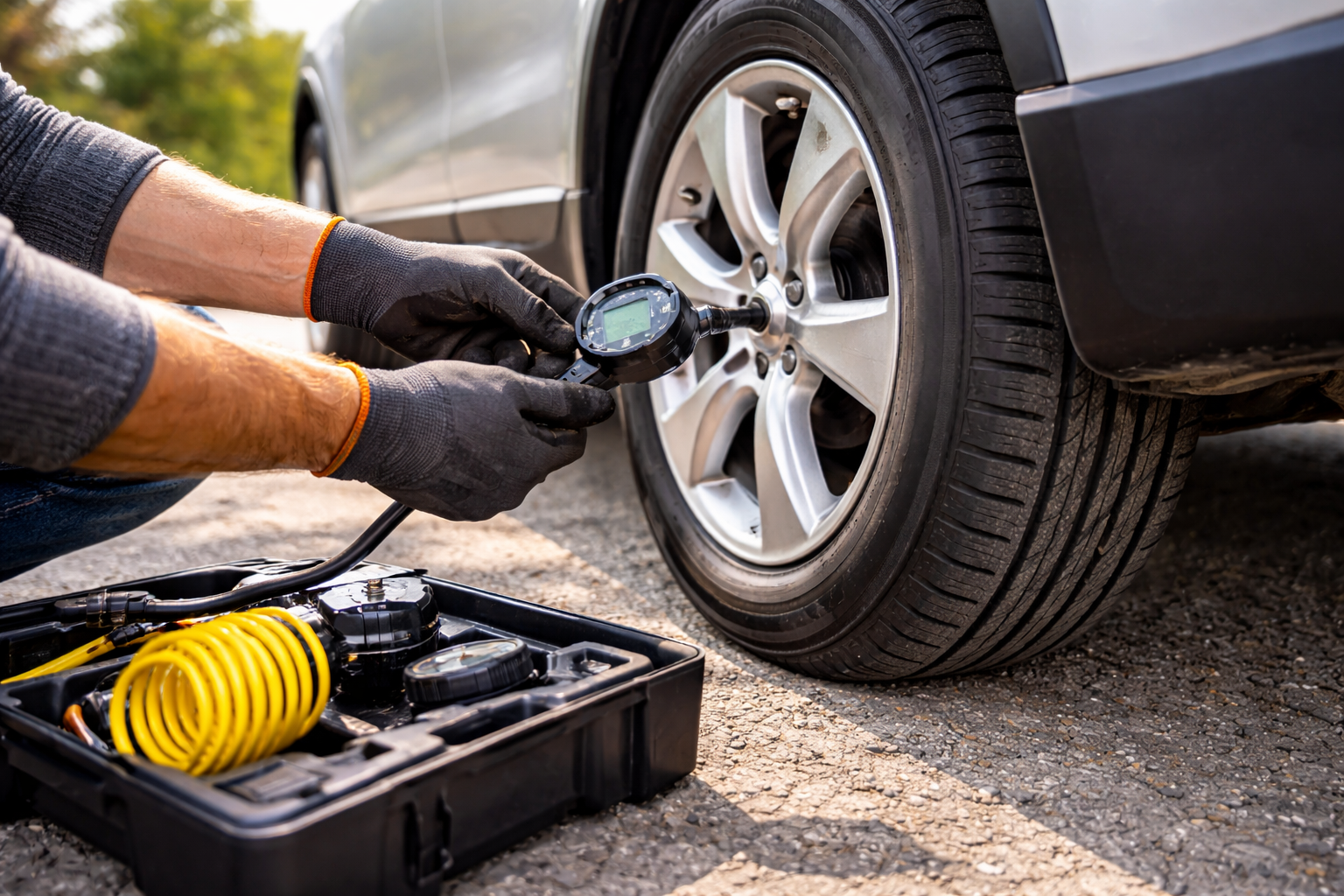
Tire pressure is the single most commonly neglected piece of vehicle maintenance. Nearly one in four passenger vehicles on U.S. highways is running on at least one significantly underinflated tire, according to NHTSA. Underinflation generates heat — and heat is the leading cause of tire failure.

Check pressure cold, before you've driven anywhere that morning. The recommended PSI is on the driver's door jamb sticker, not the tire sidewall (the sidewall number is the maximum, which is different). For most Memphis families loading up a minivan or SUV for spring break or a summer vacation run to Gulf Shores, that number is somewhere between 32 and 36 PSI. Add passengers, luggage, and a roof rack, and you're adding load — consult your owner's manual for load-adjusted pressure if you're carrying near capacity.

Don't forget the spare. A spare at 15 PSI does nothing for you at mile marker 40 on I-40. Check it every few months and before any long trip.

"I can look at a tire and tell you a lot — uneven wear tells me about alignment and inflation history, sidewall cracking tells me about age. But pressure is invisible. A tire can look completely normal and be 12 PSI low. That's the one that fails at 75 miles an hour."

Greg Baumgarten, Lead Technician — speaking about pre-trip tire checks

Reading the Tread

The quarter test is simple: insert a quarter into the tread groove with Washington's head pointing down. If you can see the top of his head, you're at or below 4/32" — marginal, especially in wet conditions. The traditional penny test (Lincoln's head) catches you at 2/32", which is the legal minimum in most states, but by that point stopping distances in rain have already increased by 30–40% compared to new tires.

Look for uneven wear patterns too. Wear concentrated in the center of the tread usually means chronic overinflation. Wear on both outer edges suggests underinflation. Heavy wear on just one edge points to an alignment issue — which means your tires are scrubbing against the road at an angle every mile you drive.

  • Center wear: chronic overinflation; adjust pressure and rotate
  • Edge wear: chronic underinflation; the most dangerous pattern for heat buildup
  • One-sided wear: alignment or suspension problem; fix before a long trip
  • Cupping or scalloping: worn shocks or struts; the tire is bouncing instead of rolling
  • Feathering: toe alignment is off; add rotation and alignment check

Sidewall Condition and Tire Age

Sidewall cracks, bulges, and embedded objects all warrant a close look. A sidewall crack usually means the rubber has oxidized — age and UV exposure break down the compounds that keep rubber flexible. Memphis gets intense summer sun, and cars parked outside accumulate years of UV damage faster than you might expect.

Tire manufacturers generally recommend replacement at six years regardless of tread depth, and consider ten years an absolute maximum. The date code is molded into the sidewall: a four-digit number in an oval, where the first two digits are the week and the last two are the year. "2219" means the 22nd week of 2019. If your tires are from before 2020, they deserve a close look regardless of how they appear.

Rotation and Alignment

Rotation should happen every 5,000–7,500 miles. It's often done with an oil change. Alignment should be checked annually or whenever you notice the car pulling to one side. Both extend tire life significantly — a set of tires that lasts 50,000 miles with proper rotation and alignment might only last 30,000 without it.

Before a road trip is also a natural time to check wheel balancing. An out-of-balance tire vibrates at highway speeds, which fatigues the tread and the driver. If you notice a vibration between 55 and 70 mph that smooths out at higher or lower speeds, that's almost always a balance issue.

Get the Check Before You Go

Our pre-trip inspection includes a full tire assessment — pressure, tread depth measurement, sidewall inspection, and a look at wear patterns that may indicate a deeper alignment or suspension issue. The inspection runs $49.95 and takes less than an hour.

Sources & Further Reading

Book your pre-trip tire check online or call (901) 388-7390. We've been on Elvis Presley Boulevard since 1974, and we'd rather catch a tire problem in our bay than have you catch it somewhere on I-40 between here and Jackson.

Article by Sherry Snell

Sherry Snell

Sherry Snell is the owner and office manager of Snell Automotive, a family-owned auto repair shop serving Memphis since 1974. With over 30 years of experience, she oversees daily operations, customer relations, scheduling, and office management — ensuring every customer receives honest, reliable service. Known for her attention to detail and commitment to transparency and quality, Sherry is a trusted and familiar presence who plays a vital role in the continued success of Snell Automotive.

Snell Automotive

Get in Touch