
Schedule Service
Snell Automotive

Oil Leaks Explained: What’s Normal, What’s Not, and When to Fix It

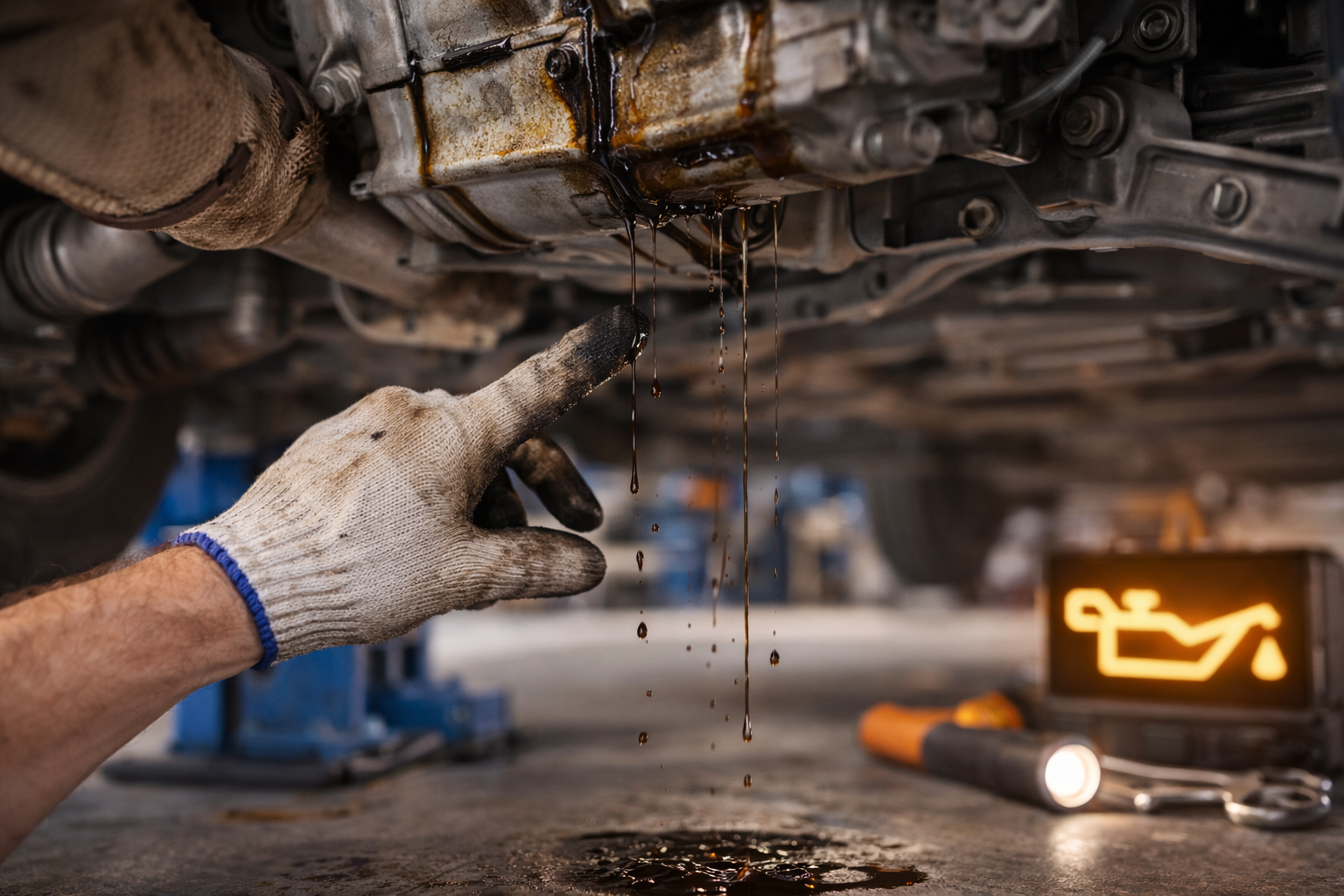
The dark stain on your driveway or garage floor is easy to ignore. The car runs fine, nothing's beeping, and you tell yourself you'll deal with it later. Memphis drivers do this constantly, and it's one of the patterns we see most at Snell — a small, cheap-to-fix oil leak that becomes an engine problem because the oil level quietly dropped over weeks until something critical ran dry.

Engine oil leaks are almost always fixable. The question is whether you fix them before or after they cause secondary damage.

Where Oil Leaks Come From

Engines are sealed systems — oil circulates under pressure through galleries, around the crankshaft, up through the cylinder head, and back again. Every seam in that system is a potential leak point. The most common sources in Memphis vehicles, where heat cycling is severe:

  • Valve cover gaskets — the rubber gaskets that seal the top of the engine. Heat hardens and shrinks them over time. The oil that drips onto a hot exhaust manifold and produces that burning smell in your engine bay is usually a valve cover gasket.
  • Oil pan gasket — seals the bottom of the engine. A slow drip from underneath the car, forward of the rear wheels, is often this gasket. Old-style cork gaskets crack; modern silicone-formed gaskets last longer but can still fail.
  • Rear main seal — seals the crankshaft where it exits the back of the engine. A rear main seal leak is usually a heavier drip, centered under the car. More involved to access but necessary to repair.
  • Front crankshaft seal — similar to the rear main, this seal is around the front of the crankshaft. Often replaced at the same time as a timing belt since the belt has to come off anyway.
  • Oil pressure switch or sending unit — sometimes a fitting, not a gasket, is the leak source. These are inexpensive to replace.

How to Tell If It's Actually Oil

Not every drip under your car is oil. Transmission fluid is red. Coolant is green, orange, or pink and has a slightly sweet smell. Power steering fluid is usually clear to light amber. Engine oil is dark brown to black, and it has a distinct petroleum smell — especially when it hits a hot surface and burns.

The location of the drip matters too. Oil tends to drip from the front half of the engine and collect near the center or front of the car under the hood area. A puddle at the very front may be coolant from the radiator. A puddle toward the rear and center is more likely transmission fluid or a rear main seal.

"People come in and say 'I think I have an oil leak' and point to a black drip. Half the time it's actually a small exhaust leak that's blowing soot, or it's old oil that baked onto something years ago and is now just discoloring the concrete. The other half the time it's a real leak. I'd rather have someone come in and find out it's nothing than have them ignore something real for six months."

Greg Baumgarten, Lead Technician — 20+ years tracking oil leaks in Memphis vehicles

Why Memphis Heat Accelerates Seal Failure

Rubber and silicone seals age through heat cycling — expanding when hot, contracting when cold, over and over. In a climate where ambient temperatures swing from 25°F in January to 95°F in August, and where engine compartment temperatures can peak above 220°F, seals wear faster than in moderate climates. Cars with 60,000–80,000 miles that would be seal-fresh in cooler climates often need gasket work in Memphis.

We also see valve cover gaskets fail more frequently on vehicles that spend a lot of time idling in traffic — the engine runs hot without airflow to cool the compartment, and the gaskets bake harder and crack faster.

What Ignoring It Actually Costs

A valve cover gasket job typically runs in the $300–$500 range. An oil pan gasket is similar. A rear main seal runs higher due to access — closer to $500–$800 in most cases. These are real expenses, but they're predictable and bounded.

What's not predictable is what happens when you run low on oil because a slow leak has been draining your level for weeks. Oil pressure drops, bearings run dry, cam lobes wear without adequate lubrication. Minor engine repairs escalate into rebuild territory fast. The difference between a $400 gasket repair and a $3,000 engine repair is usually about two oil level checks and a willingness to schedule the fix.

Diagnostic fee: $89.95. Labor: $95/hr. We'll find the source, show you what we found, and give you a straight number.

Schedule your inspection

call (901) 388-7390

Article by Sherry Snell

Sherry Snell

Sherry Snell is the owner and office manager of Snell Automotive, a family-owned auto repair shop serving Memphis since 1974. With over 30 years of experience, she oversees daily operations, customer relations, scheduling, and office management — ensuring every customer receives honest, reliable service. Known for her attention to detail and commitment to transparency and quality, Sherry is a trusted and familiar presence who plays a vital role in the continued success of Snell Automotive.

Snell Automotive

Get in Touch