
Schedule Service
Snell Automotive

What Do Your Dashboard Warning Lights Actually Mean?

The dashboard lit up on your way to work, and now you're doing the thing everyone does: trying to decide if this is a "pull over immediately" situation or a "probably fine until the weekend" situation. The answer depends almost entirely on which light came on — and the visual shorthand most drivers use (red is bad, yellow is caution, green is fine) is accurate in broad strokes but fails exactly when the details matter most.

Here's what the most common warning lights actually mean — and how to make the right call in the moment.

Lights That Mean Pull Over Now

Some warnings represent conditions that can destroy your engine or transmission in minutes if you keep driving. These are not "schedule service soon" signals.

Oil Pressure Warning (red oil can). This is the one that matters most. If your oil pressure drops, your engine's moving parts are running without lubrication. Metal on metal. Pull over, shut the engine off, and call for a tow. Driving even two miles on low oil pressure can cause catastrophic engine damage that costs more to repair than the car is worth. This is not hyperbole — we see it happen.

Engine Temperature Warning (red thermometer or "TEMP"). Overheating destroys head gaskets, warps cylinder heads, and seizes engines. Pull over as soon as it's safe, turn off the engine, and wait for it to cool before opening the hood. Do not remove the radiator cap while the engine is hot. In Memphis summer heat, overheating can happen fast — especially if a coolant hose has failed or the water pump has given out.

Brake Warning Light (red circle or "BRAKE"). If this comes on while driving (not just during startup), it typically means low brake fluid or a hydraulic pressure failure. Both are serious. If the brake pedal feels spongy or requires more pressure than usual, pull over immediately — you may be losing braking ability.

Lights That Mean Schedule Service This Week

These don't require an immediate stop, but ignoring them for months is how small problems become expensive ones.

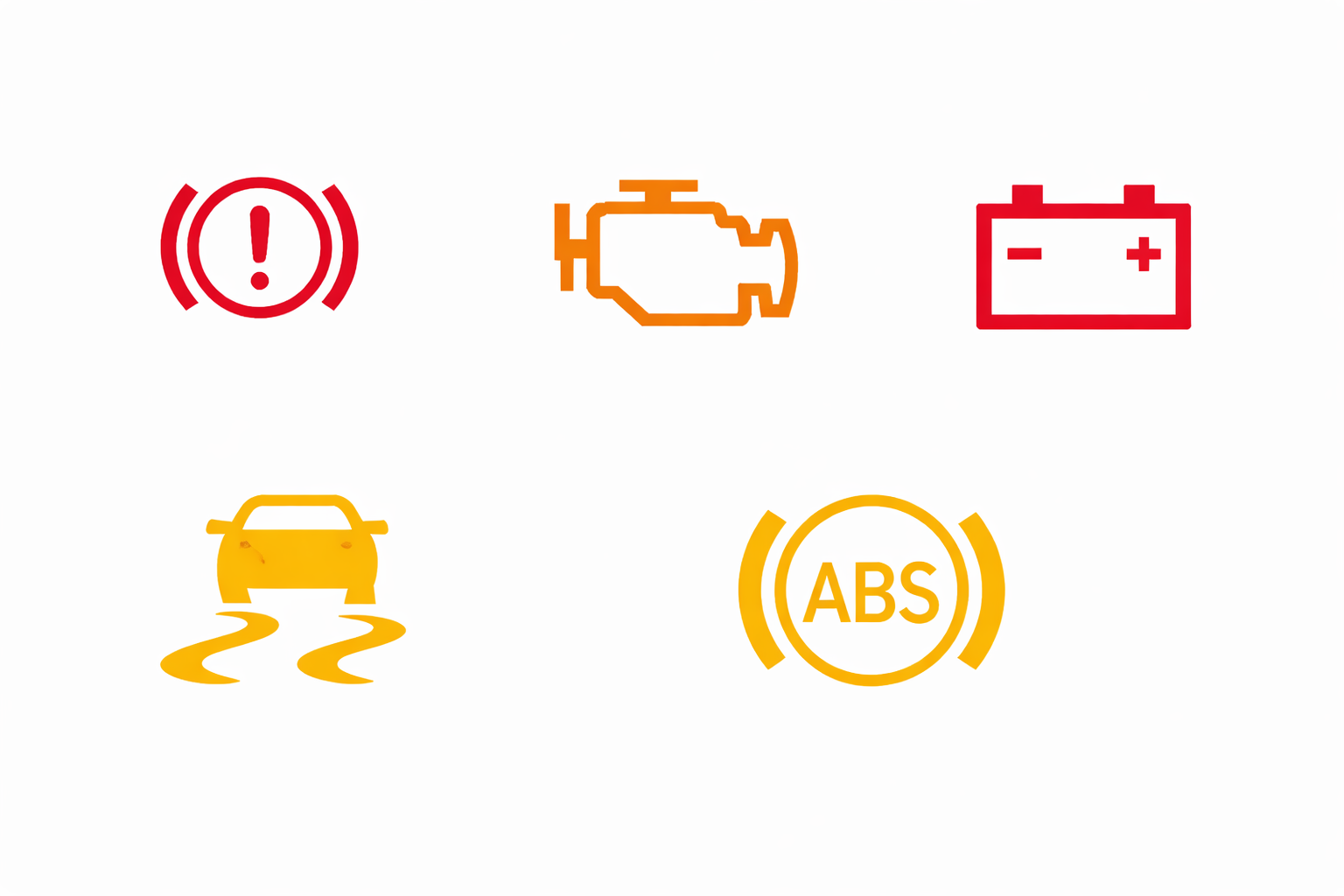
Check Engine Light (yellow engine outline). The most misunderstood warning in existence. It means the engine control unit has detected a fault and stored a code — but "fault" ranges from a loose gas cap (a 10-second fix) to a misfiring cylinder (a real problem) to an emissions system issue (may or may not affect drivability). If the light is solid and the car drives normally, you have time to schedule a diagnostic. If it's flashing, that indicates an active misfire that can damage the catalytic converter — treat it like a pull-over-soon situation.

ABS Warning (yellow "ABS"). Your standard brakes still work. The anti-lock braking system — which prevents wheel lockup during hard braking — has detected a fault and disabled itself. You can drive, but your stopping ability in emergency situations is reduced to pre-ABS capability. Get it checked within the week.

Traction Control / Stability Control (yellow car with skid lines). Similar to ABS — the system has detected a fault and disabled traction assist. Normal driving is unaffected, but you've lost electronic stability help in slippery conditions. Given Memphis's tendency toward ice on bridges in winter and flooded streets in spring, don't let this sit.

TPMS (yellow exclamation in a tire cross-section). Tire pressure is low in at least one tire. Check all four plus the spare as soon as it's convenient — a significantly low tire affects handling and fuel economy and can fail at highway speed. Memphis potholes on I-240 and Lamar Avenue have ended many a tire prematurely.

"The one that breaks my heart is the oil pressure light that someone drove on. By the time they get here the engine's already done. A tow costs $120. A new engine costs $4,000 to $8,000. I've had this conversation too many times. When that red oil can comes on, the car is done moving under its own power — period."

Greg Baumgarten, Lead Technician — on the consequences of ignoring oil pressure warnings

Lights That Are Often Misread

Battery light (red battery symbol). This doesn't mean the battery is dying — it means the charging system isn't charging. While you drive with this on, you're drawing down the battery reserve with no replenishment. You have 20–45 minutes of driving time before the car dies completely, depending on what's on (headlights, A/C, and heated seats accelerate the drain). Get to a shop quickly.

Service Engine Soon vs. Check Engine. Some manufacturers use both, with different meanings. Generally "Check Engine" is emissions/powertrain related; "Service Engine Soon" may indicate a scheduled maintenance interval. Know which light your car has and what it's labeled.

Tire Pressure Low vs. TPMS Fault. A flashing TPMS light (as opposed to steady) indicates a fault in the monitoring system itself — typically a sensor battery that's died or a sensor damaged by a pothole. The monitoring isn't working, not necessarily the tires.

What Happens During a Diagnostic Scan

When a warning light sends you to Snell, the first step is a full module scan — not just the engine, but all available control modules. Some warning lights are triggered by faults in secondary modules that communicate through a shared network. Reading only the powertrain module misses faults stored in the ABS module, body control module, or transmission control module.

The scan reads stored codes, pending codes (conditions that have been seen but haven't triggered a light yet), and freeze frame data. Our $89.95 diagnostic covers this scan and an initial assessment of what the codes mean for your specific vehicle. That fee applies toward the repair when you proceed.

After diagnosis, we give you a straight answer: what the fault is, what it will take to fix, and what happens if you don't. No pressure, no inflation — just the actual situation.

Schedule a warning light inspection or call (901) 388-7390. We're on Appling Way — open Monday through Friday, 8 to 5.

Sources & Further Reading

Article by Sherry Snell

Sherry Snell

Sherry Snell is the owner and office manager of Snell Automotive, a family-owned auto repair shop serving Memphis since 1974. With over 30 years of experience, she oversees daily operations, customer relations, scheduling, and office management — ensuring every customer receives honest, reliable service. Known for her attention to detail and commitment to transparency and quality, Sherry is a trusted and familiar presence who plays a vital role in the continued success of Snell Automotive.

Snell Automotive

Get in Touch