
Schedule Service
Snell Automotive

Faulty Sensors and Control Modules: Why Modern Cars Need Diagnostics

Your car has more sensors than a 1990s NASA spacecraft. A modern mid-size sedan can have upward of 60 to 70 sensors monitoring everything from oxygen levels in the exhaust to the precise rotational speed of each wheel. Most of them work quietly for 100,000 miles and never ask for attention. But when one fails — or starts giving subtly wrong readings — it can make a perfectly functional engine behave like something is seriously wrong, or make a genuinely broken system look fine until it isn't.

Understanding how sensor diagnostics work helps Memphis drivers make smarter decisions about repair. "Replace the sensor" sounds simple. The reality is more layered.

Sensors Are Reporters, Not Actors

This is the distinction that matters most: sensors report conditions; they don't control them. The oxygen sensor doesn't control fuel delivery — it reports exhaust oxygen content so the engine control unit can adjust fuel delivery. The mass airflow sensor doesn't decide how much fuel to inject — it reports how much air is entering the engine so the ECU can calculate the right fuel mixture.

When a sensor fails, two things can happen. First, the ECU notices the signal is implausible — it stores a fault code, turns on the check engine light, and runs on default values. Second, and trickier: the sensor keeps reporting, but starts reporting wrong. No fault code. No warning light. Just an engine that's running slightly rich, slightly lean, or slightly off in ways that hurt fuel economy and power before they ever trigger a code.

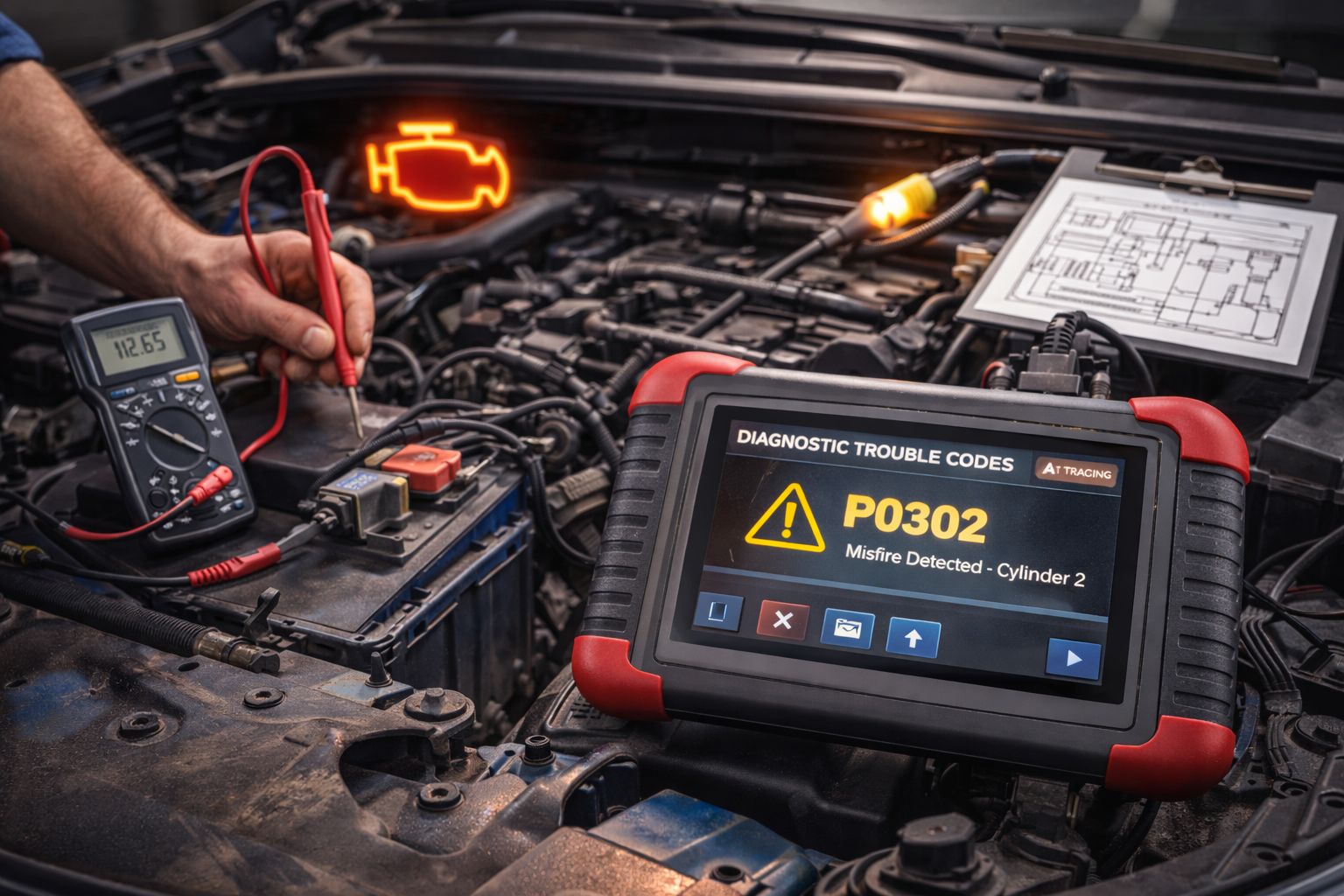
Diagnosing sensor failures correctly requires reading live data — watching what the sensor actually reports in real time — not just pulling codes and matching them to a parts catalog.

The Sensors Memphis Heat Kills First

Sensors are electronic components, and electronic components degrade faster under sustained heat stress. Memphis summers accelerate this in specific, predictable ways:

Mass airflow (MAF) sensors sit in the intake tract and get contaminated by oil vapor from the PCV system. Heat makes the contamination deposit faster. A dirty MAF reports lower airflow than actually exists, causing the ECU to run lean — rough idle, hesitation, poor mileage. Cleaning solves it sometimes; replacement at around $150–$280 solves it when the hot wire element is burned.

Oxygen sensors live in the exhaust stream at temperatures above 1,200°F. The ceramic element degrades with age, but heat cycling accelerates it. A lazy O2 sensor that responds slowly to fuel mixture changes causes the ECU to overcorrect, burning more fuel. Upstream sensors run $120–$200 parts and labor; downstream sensors are usually cheaper but harder to access.

Crankshaft and camshaft position sensors sit near the engine block and see sustained high temperatures. When they fail, you often get a no-start or a stall — sometimes at highway speed. The failure is usually intermittent at first, which makes it maddeningly hard to catch.

"The ones that drive me crazy are the crank sensors that fail when hot. Car stalls on the interstate, tows in, starts right up in the shop. We hook up the scanner and drive it on the lift until it acts up. Some days that takes two hours. But that's the only way to actually catch it — you have to see the sensor drop out live."

Greg Baumgarten, Lead Technician — on heat-induced intermittent sensor failures

Control Modules: When the Brain Has a Problem

Control modules — the ECU (engine), TCM (transmission), BCM (body), ABS module, and others — are computers that process sensor data and send commands. They fail less often than sensors, but when they do, the diagnostics get complicated fast.

A faulty module can produce sensor-like fault codes because it's misinterpreting good data. Or it can produce no codes at all because it's failing in a way that doesn't trigger its own self-checks. Confirming a module failure requires ruling out every sensor, connector, and wiring path that feeds it first — otherwise you're replacing a $400 computer when the real problem is a corroded $8 connector.

This is where an experienced diagnostician earns their fee. Module replacement without thorough upstream testing is a guess dressed up as a diagnosis.

What the Diagnostic Process Actually Covers

Our $89.95 diagnostic at Snell includes:

  • Full scan of all modules — not just the engine, but transmission, ABS, body, HVAC, and any others equipped
  • Live data review for key sensors while the engine runs
  • Freeze frame data to see what conditions were present when the fault stored
  • Connector inspection at suspected sensor locations
  • Wiring continuity check if the fault points to a circuit rather than the sensor itself

That last point matters. A fault code that says "O2 sensor circuit low" could mean a dead sensor, a broken wire, a corroded connector, or a bad ground. We test the circuit before we order a part.

Common Misdiagnoses and What They Cost

The most expensive sensor diagnostic mistake is replacing a sensor before confirming it's actually failed. This happens when a shop reads a code, matches it to a part number, and installs without testing. The code comes back. Now you're $200 in on a part that didn't solve anything, and you still have a diagnosis to do.

Equally expensive is the inverse: assuming a sensor code means the sensor is bad when the real problem is upstream. Replacing a MAP sensor when the intake manifold has a vacuum leak just wastes the sensor. The leak is still there.

Proper sensor diagnostics saves money not because the testing is cheap — our labor rate is $95/hr — but because it prevents the cycle of replacing parts until something sticks.

Schedule a diagnostic at Snell Automotive or call (901) 388-7390. We're at 2848 Appling Way, Monday through Friday 8–5.

Sources & Further Reading

Article by Sherry Snell

Sherry Snell

Sherry Snell is the owner and office manager of Snell Automotive, a family-owned auto repair shop serving Memphis since 1974. With over 30 years of experience, she oversees daily operations, customer relations, scheduling, and office management — ensuring every customer receives honest, reliable service. Known for her attention to detail and commitment to transparency and quality, Sherry is a trusted and familiar presence who plays a vital role in the continued success of Snell Automotive.

Snell Automotive

Get in Touch