
Schedule Service
Snell Automotive

What Causes Electrical Problems in Modern Vehicles?

The electrical system in a modern vehicle is not one system. It's a network of interconnected systems — power generation, distribution, communication, and control — that work together so seamlessly when healthy that most drivers never think about them. When something goes wrong, that same interconnection means a fault in one area can produce symptoms in a completely unrelated area. A bad ground on the passenger side of the engine bay can make the fuel trim go haywire. A failing body control module can cause ABS faults. A corroded connector under the rear seat can make the transmission shift erratically.

Electrical diagnostics is the process of separating signal from noise in a system designed so that everything talks to everything else. Done well, it's methodical and precise. Done poorly, it's replacing parts until something sticks.

Warning Signs That Something Electrical Is Wrong

Electrical problems announce themselves in patterns that are worth knowing. These are the signals we see most often at Snell, in the order that usually indicates severity:

  • Multiple warning lights on simultaneously — often a sign of a single upstream fault (bad ground, failing module) affecting multiple systems at once
  • Accessories that are intermittently inoperative — windows, locks, mirrors that work sometimes and not others; often a connector or relay issue
  • Unusual behavior when the car is hot — faults that appear after 20–30 minutes of highway driving and resolve after cooling are classic heat-expanded connection failures
  • Lights that flicker or dim — voltage fluctuation from a weak alternator, bad battery, or high-resistance connection in the main power circuit
  • Electronics that reset — radio losing presets, clock resetting, module adaptive memory clearing; often indicates voltage spikes or momentary power loss
  • Strange smells — burning plastic or an acrid electrical smell is a wiring fault that's generating heat and needs immediate attention
  • Circuit breakers that trip repeatedly — a circuit that keeps blowing its fuse has a load problem or a short; replacing the fuse without finding the cause is a fire risk

How the Modern Vehicle Network Is Structured

Understanding the architecture helps make sense of why electrical problems behave the way they do. Most vehicles built in the last 15 years use a CAN bus (Controller Area Network) — a shared communication backbone that allows all the onboard computers to share data without running a dedicated wire between every pair of modules.

The engine control module knows the vehicle speed because the transmission control module publishes it to the CAN bus. The instrument cluster reads it from there. The stability control system reads the same speed. One source, many consumers. When the network works, this is elegant. When the network has a problem — a module that's corrupting data, a wire with intermittent continuity — the symptoms can appear in every module that's trying to read the affected signal.

This is why diagnosing electrical problems correctly requires reading all modules, not just the one that lit up a warning light.

"People come in thinking they have an ABS problem because the ABS light is on. Half the time the ABS system is fine — it's responding to bad wheel speed data from a sensor or a fault somewhere on the network that's corrupting the signal. If I only look at ABS codes I'll miss the real problem every time. You have to start from the network level and work down."

Greg Baumgarten, Lead Technician — on why multi-module scanning is non-negotiable

The Diagnostic Equipment That Makes the Difference

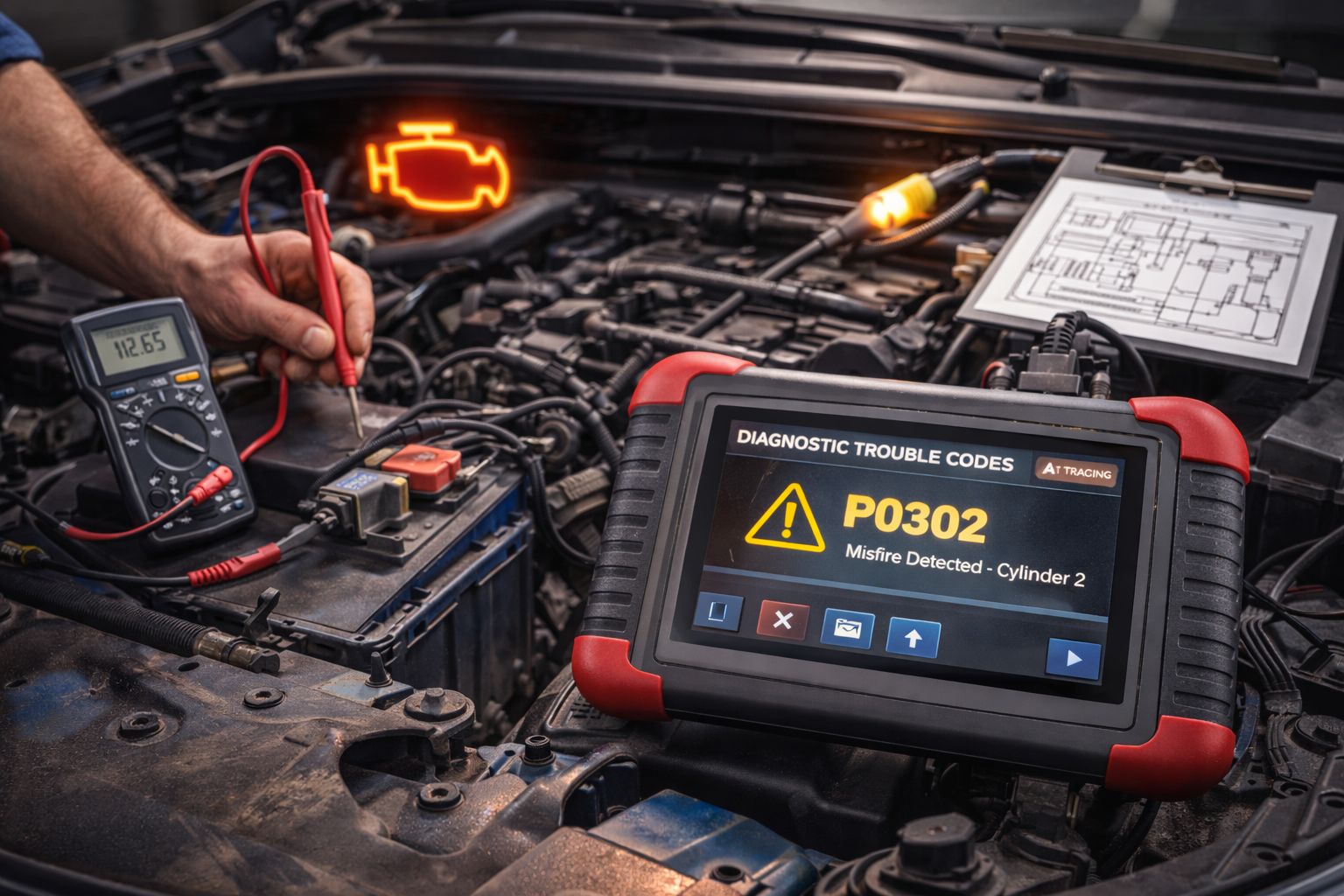
Not all diagnostic equipment is equal. The difference between a $50 code reader from an auto parts store and a professional scanner isn't primarily the list of codes — it's the depth of data access.

Professional scanners like the Snap-on ZEUS and Autel MaxiSys Ultra that we use at Snell access not just fault codes but live sensor data streams, actuator command outputs, bidirectional control tests (we can command a component to operate and verify it responds), and network communication status. That level of access is what separates "the computer says replace the sensor" from "we tested the sensor, confirmed it's working, and traced the fault to the connector 18 inches upstream."

We also use oscilloscopes for waveform analysis — particularly for ignition systems, fuel injectors, and CAN bus signals — and thermal imaging cameras for finding connections that are generating heat without showing visible damage.

The Diagnostic Process, Step by Step

When you bring an electrical complaint to Snell, here's what happens:

The first 10 minutes are history-taking. When did it start? What conditions? Any recent service, accidents, modifications? This context matters — an electrical problem that started right after an oil change has different suspects than one that appeared gradually over six months.

Then a full module scan. Every module in the network, every stored and pending code, freeze frame data for any codes that have stored. This takes 15–20 minutes on a complex vehicle and gives us a map of where the network thinks the problems are.

Then physical inspection — the connectors, grounds, and wiring that serve the suspect circuits. Memphis humidity makes this step particularly important. Corrosion inside a connector won't show up on a scan, but it shows up under a flashlight.

Then component testing. Not just reading what a sensor reports, but verifying it against known-good values using the oscilloscope or bidirectional controls. Confirming that a module is commanding an output and that the output is actually happening.

Total diagnostic time for a clear fault: 1–2 hours. For an intermittent fault that requires data logging or extended testing: 2–4 hours. Our diagnostic fee starts at $89.95, applied toward your repair; labor is $95/hr.

The Memphis Electrical Environment

Fifteen years of Memphis summers and winters compresses a lot of wear into a vehicle's electrical system. The wiring harnesses on vehicles that have lived here their whole lives — bought at a Germantown dealership in 2010, driven to downtown offices every day, sitting in surface lots in 95°F heat for eight hours — have experienced thousands of heat cycles. Connectors that Toyota or Ford designed to last 20 years in average conditions may last 12–15 in Memphis.

This isn't a complaint about build quality — it's physics. Thermal cycling fatigues metal, dries out insulation, and oxidizes contact surfaces. A vehicle's electrical age in Memphis is roughly 1.3–1.5x its calendar age. We diagnose with that context in mind.

Schedule an electrical system diagnostic or call (901) 388-7390. Snell Automotive, 2848 Appling Way — Monday through Friday, 8 to 5.

Sources & Further Reading

Article by Sherry Snell

Sherry Snell

Sherry Snell is the owner and office manager of Snell Automotive, a family-owned auto repair shop serving Memphis since 1974. With over 30 years of experience, she oversees daily operations, customer relations, scheduling, and office management — ensuring every customer receives honest, reliable service. Known for her attention to detail and commitment to transparency and quality, Sherry is a trusted and familiar presence who plays a vital role in the continued success of Snell Automotive.

Snell Automotive

Get in Touch