
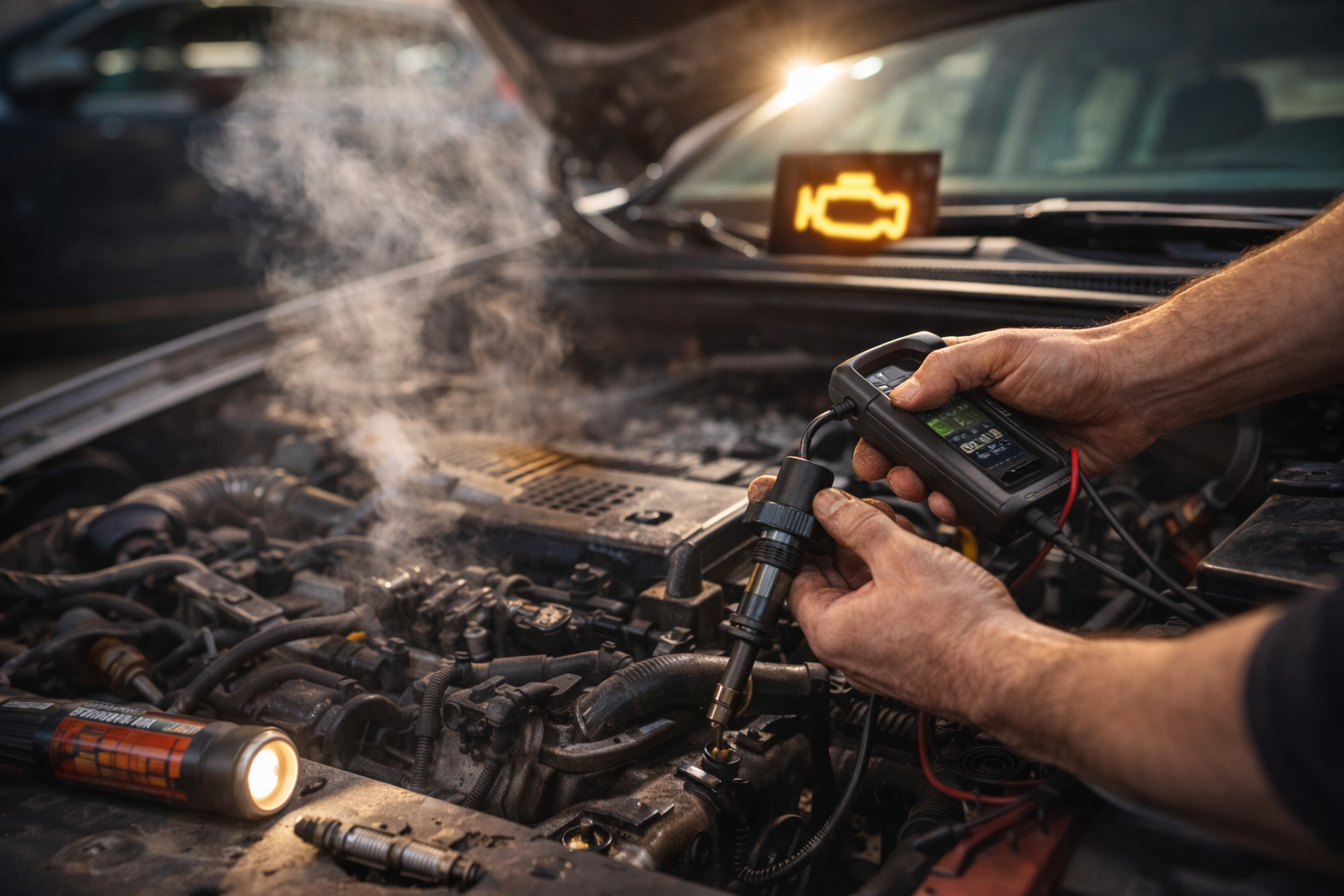
Your engine fires each cylinder in a precise sequence. When a cylinder misfires, that means the combustion event didn't happen correctly — either the spark didn't happen, the fuel mixture wasn't right, or the compression wasn't sufficient to ignite the mixture properly. One cylinder failing to fire means the engine produces an uneven power pulse, which shows up as a shake or vibration. At idle, where the engine is spinning slowly and each power stroke is spaced further apart, a single cylinder misfire is very noticeable. At highway speed, with thousands of power strokes per minute, it may just feel like a subtle vibration or slight power loss.
A rough idle is one of the most disorienting things a car can do. Everything looks fine — you're not moving, nobody's honking, nothing dramatic has happened — but the car is shaking under you like something's wrong. And something usually is. That shake is your engine telling you that one or more of its cylinders is firing inconsistently, or not at all, and the rest of the engine is compensating for the imbalance.
Engine misfires are worth understanding because they range from "fix it this week" to "don't drive this car," depending on what's causing them. Here's how to read the difference.
What a Misfire Actually Is
The Most Common Causes
Misfires have a short list of usual suspects, and most of them are inexpensive to fix if you catch them before they cause secondary damage:
- Spark plugs — worn or fouled plugs are the most common cause of misfires. A plug that can't produce a reliable spark will misfire under load, at idle, or both. Standard interval is 30,000–100,000 miles depending on plug type.
- Ignition coils — modern engines have a coil for each cylinder. When one fails, that cylinder misfires consistently. The car may shake at idle but smooth out at higher RPM.
- Fuel injectors — a clogged or failing injector doesn't deliver the right amount of fuel. The cylinder starves, the mixture is off, the combustion event is weak or incomplete.
- Vacuum leaks — air entering the intake where it shouldn't throws off the air-fuel ratio. Memphis humidity is hard on rubber vacuum hoses; they crack and shrink over time.
- Low compression — a cylinder with a bad valve, worn rings, or a damaged head gasket can't build enough pressure to properly ignite the mixture. This is more serious and points toward mechanical wear.
"When someone comes in with a misfire, the first thing I'm asking is: does the check engine light flash, or is it steady? A flashing light means active misfire happening right now, and if it's flashing on a cold start and stays flashing, that car needs to come off the road until we look at it. A steady light with a rough idle is usually something we can diagnose and schedule. The flash changes the urgency."
Why the Check Engine Light Flashes
Modern engine management systems monitor combustion events in real time. When a cylinder misfires, the computer logs it. If the misfire is severe enough — especially if unburned fuel is being pushed into the exhaust and could damage the catalytic converter — the check engine light doesn't just come on. It flashes. A flashing check engine light is the system's way of telling you that active damage may be occurring right now. Drive it to us or pull over; don't drive it across town.
The Memphis Heat Connection
Ignition coils and spark plugs both wear faster in heat-stressed environments. Memphis summers, with engine compartment temperatures that can exceed 200°F on a 95-degree day, age these components faster than moderate climates do. We also see more vacuum line failures here — the rubber degrades under repeated heat-cool cycles. If your car is starting to miss, especially after a summer, the ignition system and vacuum hoses are the first things to look at.
Minor engine repairs — plug replacement, coil replacement, injector service — typically run $300–$800 depending on the vehicle and access. Catching the misfire before it damages an oxygen sensor or catalytic converter keeps you in that range. Waiting turns a $300 fix into a $1,200 fix.
Start with a diagnostic: $89.95, labor at $95/hr. We'll pull the codes, identify which cylinder is misfiring and why, and give you a clear repair estimate.
Article by Sherry Snell

Sherry Snell is the owner and office manager of Snell Automotive, a family-owned auto repair shop serving Memphis since 1974. With over 30 years of experience, she oversees daily operations, customer relations, scheduling, and office management — ensuring every customer receives honest, reliable service. Known for her attention to detail and commitment to transparency and quality, Sherry is a trusted and familiar presence who plays a vital role in the continued success of Snell Automotive.