
Schedule Service
Snell Automotive

Why Car Batteries Fail During Seasonal Travel

Memphis sits at a crossroads — literally. I-40 runs east to Nashville, west to Little Rock. I-55 drops south toward New Orleans. Every summer, families load up cars and head for the Smoky Mountains, Gulf Shores, or Florida. Every Thanksgiving and Christmas, that same traffic reverses. And every year, a percentage of those cars don't make it past the first rest stop.

Battery failure during seasonal travel is predictable enough that it's almost preventable. Understanding why it happens — and when Memphis drivers are most vulnerable — is the difference between a family road trip and a roadside nightmare.

Why Seasonal Travel Breaks Batteries

A car battery has two jobs. The first job is obvious: start the engine. The second job is less visible but equally demanding: support the electrical system's needs during peak load — the kind of load that happens when you're running A/C at maximum, charging two phones, running GPS navigation, keeping rear-seat entertainment going, and driving at highway speed in 95°F summer heat for six hours.

Under normal daily commute conditions, a battery that's partially degraded can mask its weakness. Short trips with moderate loads don't expose the limits of a battery that's down to 70% of its original capacity. But a sustained six-hour drive in heat, with high accessory load, followed by shutting down in a highway rest stop and trying to restart — that's when the marginal battery reveals itself.

The heat factor compounds this in Memphis. Batteries degrade faster in hot climates because the chemical reactions that erode battery plates run faster at high temperatures. A battery bought in 2022 has experienced four full Memphis summers. At the national average of 4–5 year lifespan, it's approaching end of life. In Memphis heat, it may already be there.

The Two Seasonal Windows When This Happens Most

Summer travel (June–August) kills batteries through heat accumulation. The battery that survived winter and spring is depleted from months of high-demand operation. Highway driving in peak heat pushes alternator load higher, which means the alternator runs hotter, which means the battery absorbs more heat from proximity to a working alternator. By August, a marginal battery is often at its weakest point of the year.

Holiday travel (November–January) kills batteries through temperature shock. Memphis winters are mild by northern standards — rarely below 25°F — but that's a 70-degree swing from summer. A battery that was barely holding capacity in August hasn't recovered; it's just been sitting at moderate temperatures. The first genuinely cold morning of a holiday trip — 28°F at 6 AM when you're trying to get ahead of the I-40 traffic — delivers the killing blow to a battery that was already compromised.

"Every November I try to talk customers into a battery test before they drive to see family. Maybe a third of them come back in after the trip instead of before, and half of those got stranded somewhere between here and Nashville. The test takes five minutes. I'd rather do it in the shop than hear about it from a parking lot in Jackson, Tennessee."

Greg Baumgarten, Lead Technician — on pre-travel battery testing

Signs Your Battery Won't Make the Trip

Most battery failures aren't sudden — there's a window of warning that drivers miss because the symptoms are subtle:

  • Slower engine cranking — the engine turns over, but it takes an extra half-second before it catches
  • Headlights that dim when the engine starts — normal headlight flicker lasts less than a second; prolonged dimming indicates the battery is struggling to recover voltage
  • Battery light flickering at idle — may indicate alternator charging issues or a battery that can't hold the charge being delivered
  • Electronics resetting — radio presets, clock, or window memory positions that reset without explanation often indicate brief voltage drops during engine cranking
  • Age above 4 years in Memphis — even without symptoms, a battery past 4 years here has earned a test before a long trip

The Pre-Trip Checklist for Electrical Health

Two weeks before any trip over 300 miles from Memphis, bring the car in for a pre-travel inspection. On the electrical side specifically, we check:

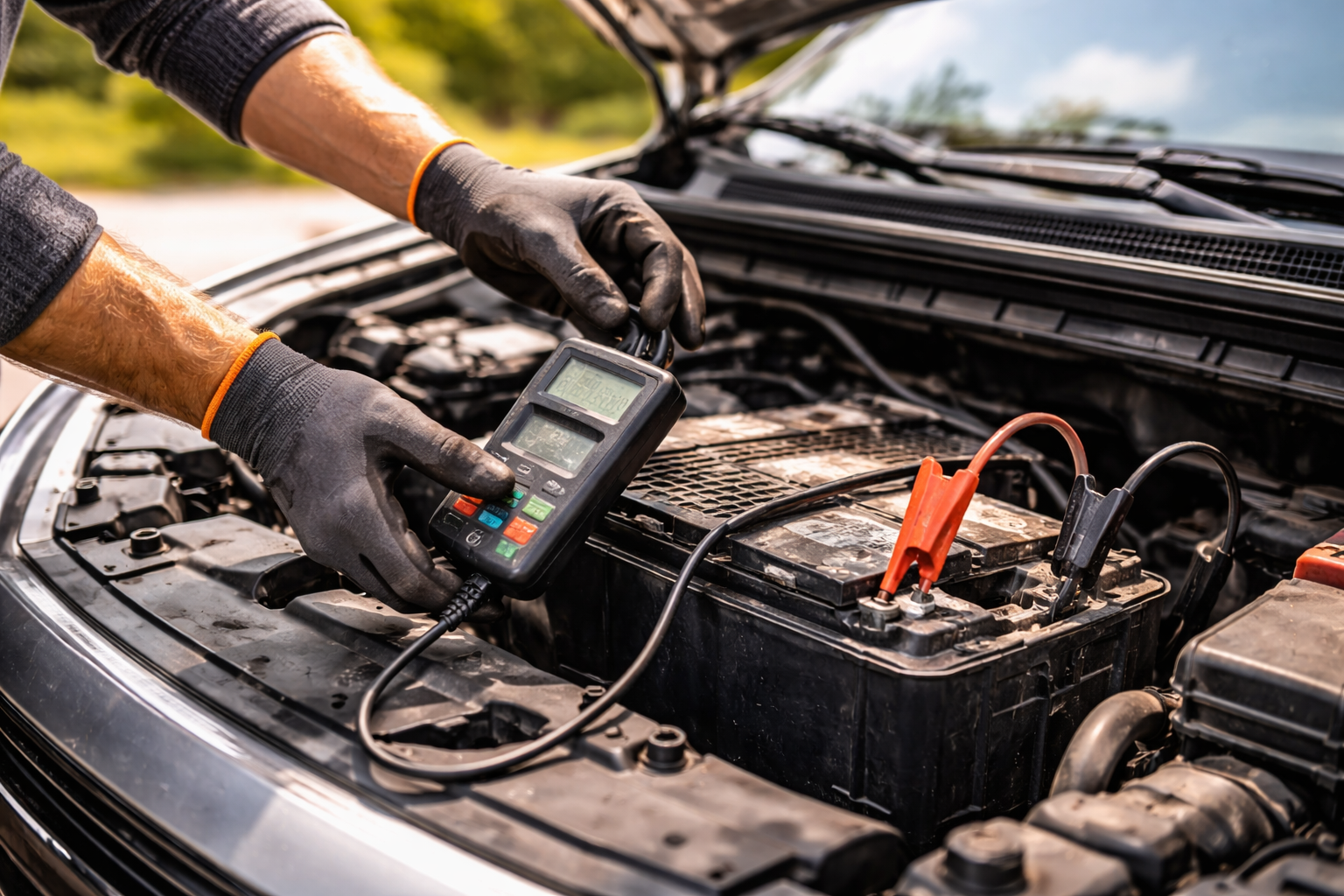
  • Battery load test (conductance test under actual amp demand — not just voltage)
  • Charging system output — alternator voltage and current at idle and at 2,000 RPM
  • Battery terminal condition — corrosion on terminals increases resistance and makes starting harder
  • Serpentine belt condition — the belt drives the alternator; a worn belt slipping under load affects charging

A pre-trip electrical inspection runs about 30 minutes and is included in our standard multi-point inspection. If the battery tests below 70% capacity, we'll show you the test result and let you decide. If the alternator output is below spec, we'll tell you what that means for a sustained highway drive.

If You Do Get Stranded

If the battery fails on the road, you'll likely be able to jump-start the car with jumper cables or a portable jump starter (a lithium jump pack is worth having in the car — they're $50–$80 and can jump a V8). The question is whether you can make it to a shop before it dies again.

A failing battery will typically allow you to drive some distance on alternator power alone — but if the alternator is also weak, or if the battery has an internal short, you may only have minutes. The safest move is to drive directly to the nearest shop rather than continuing the trip. A one-hour delay at a shop is less costly than a tow from a rural highway.

Battery Replacement at Snell

Battery replacement at Snell runs $180–$280 installed depending on your vehicle's battery size and specification (AGM batteries for start/stop systems run more than conventional batteries). We stock batteries for most domestic and import vehicles. If we don't have yours, we can usually source it same-day in Memphis. Labor rate is $95/hr; battery replacement is typically 30–45 minutes of labor.

We don't charge for the battery test itself. If you come in worried about your battery before a trip, we'll test it and tell you honestly what the result is. If it passes, you leave knowing. If it doesn't, you have a choice to make before you're stranded in Cookeville.

Schedule a pre-trip electrical inspection or call (901) 388-7390. We're at 2848 Appling Way, Memphis — open Monday through Friday, 8 to 5.

Sources & Further Reading

Article by Sherry Snell

Sherry Snell

Sherry Snell is the owner and office manager of Snell Automotive, a family-owned auto repair shop serving Memphis since 1974. With over 30 years of experience, she oversees daily operations, customer relations, scheduling, and office management — ensuring every customer receives honest, reliable service. Known for her attention to detail and commitment to transparency and quality, Sherry is a trusted and familiar presence who plays a vital role in the continued success of Snell Automotive.

Snell Automotive

Get in Touch