
Schedule Service
Snell Automotive

Why Cooling System Checks Matter Before Long Trips

There is a version of this story that ends with a plume of steam rising off the hood on the shoulder of I-40, somewhere between Memphis and Nashville, on a July afternoon when the temperature is 97 degrees and the pavement is holding heat from the last three days. The tow truck wait is two hours. The repair, once you reach a shop, turns out to be a hose that cost twelve dollars. That story happens thousands of times a year across American highways in summer.

The cooling system is what stands between your engine and that outcome. It circulates coolant through passages in the engine block and cylinder head, pulling heat away from combustion chambers running at over 1,000 degrees Fahrenheit, then moving that heat through the radiator where airflow dissipates it. At highway speeds under load — climbing grades, running the AC, towing — the system works constantly. It has very little margin for weakness.

What the System Actually Does

Modern vehicles run hotter than most drivers realize. The optimal operating temperature for most gasoline engines is around 195–220°F. The cooling system maintains that range precisely. Too cold and the engine runs inefficiently; too hot and you're seconds away from warped cylinder heads or a seized piston.

The system relies on three things working together: the coolant itself (which degrades over time and loses its heat-transfer and corrosion-inhibiting properties), the water pump (which circulates the coolant), and the thermostat (which regulates when coolant begins flowing to the radiator). A failure in any one of these can cascade quickly under sustained load.

"People think overheating is a dramatic event — gauge goes to red, you pull over. But a lot of times the engine has been running marginally hot for the last hour, and the gauge is a trailing indicator. By the time the needle hits red, you may already have damage. That's why we look at the coolant condition, not just the coolant level."

Greg Baumgarten, Lead Technician — on why visual inspection misses the real issues

Coolant Condition vs. Coolant Level

These are two different things. A cooling system that's full of degraded coolant is in worse shape than one that's slightly low on fresh coolant. Coolant has a service life — typically two years for green conventional antifreeze, up to five years for extended-life orange or pink formulations (HOAT/OAT chemistry). After that, the corrosion inhibitors break down and the coolant begins attacking the aluminum and rubber components in the system rather than protecting them.

Degraded coolant often looks visually fine. You can't assess its condition by opening the overflow reservoir and looking. We test with a refractometer and chemical test strips to check the freeze/boil protection range and inhibitor strength. This takes about five minutes and tells you definitively whether the coolant is still doing its job.

Components to Inspect

The hoses — upper and lower radiator hoses, and the smaller heater hoses — are made of rubber compounds that harden and crack over time. They're most likely to fail under the thermal cycling stress of a long highway drive. Squeeze the hoses when the engine is cold: they should feel firm but pliable. Hardness, sponginess, or visible cracking are all signs of deterioration.

  • Radiator cap: maintains system pressure; a weak cap lowers the boiling point of your coolant
  • Water pump: listen for bearing noise or whining at idle; inspect the weep hole for leaks
  • Thermostat: a stuck-open thermostat causes chronic under-temperature running; stuck-closed causes rapid overheating
  • Radiator: check for bent fins, corrosion, and insects/debris blocking airflow
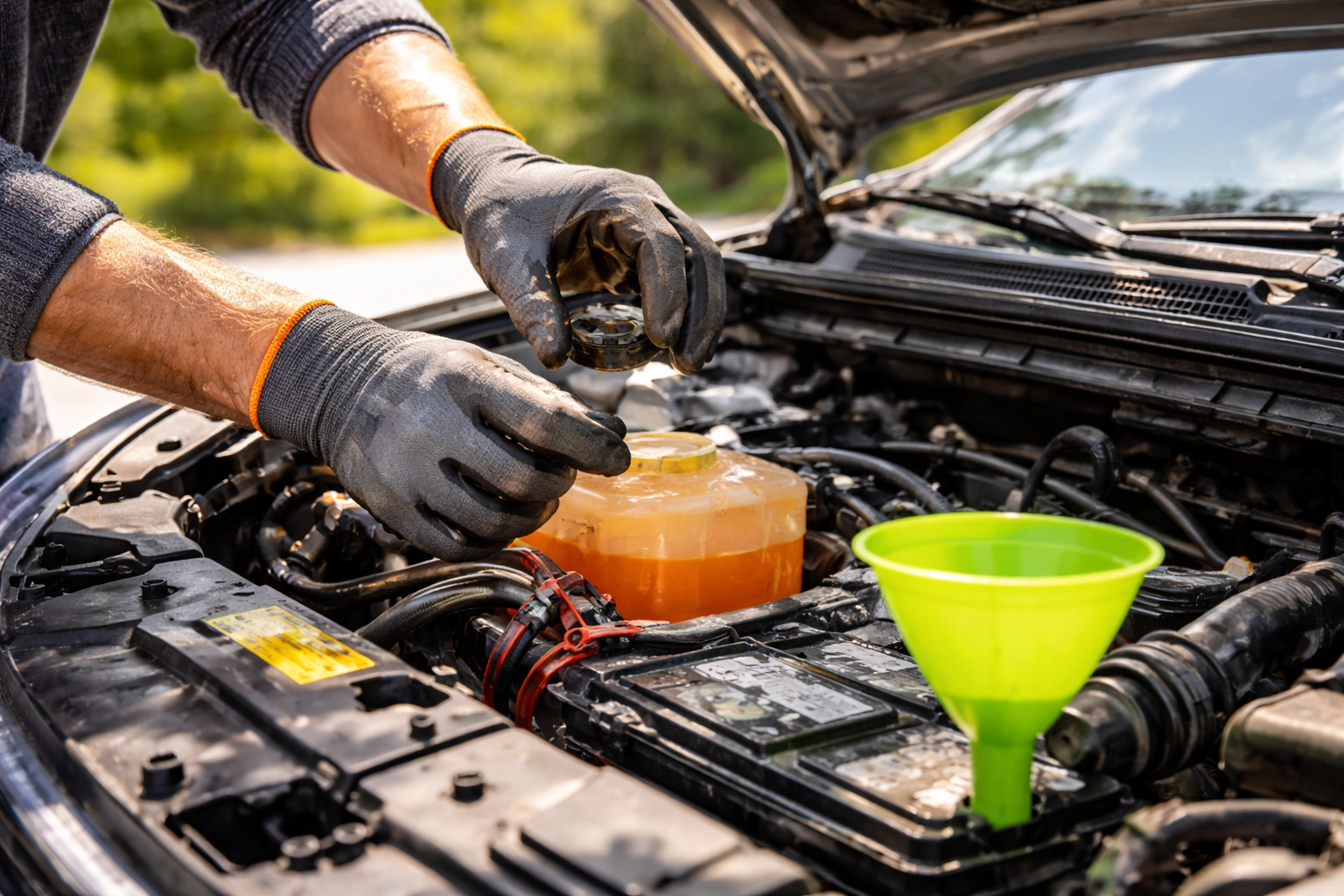
  • Overflow reservoir: check level cold; discoloration or visible rust is a warning sign

Memphis Summer Heat Is Not Forgiving

A vehicle that handles short commutes around Bartlett or Germantown without incident is not necessarily ready for four hours of continuous highway driving in August. The difference is load and duration. Daily driving gives the cooling system time to recover at traffic lights, at stop signs, in parking lots. Highway driving does not. The system runs at full capacity for the entire trip.

Memphis summers regularly push ambient temperatures into the mid-90s with high humidity. Your engine's cooling system is working against that baseline the entire time you're on the road. If there's any marginal component — a hose that's started to soften, a coolant that's lost its inhibitor strength, a radiator cap that's lost its seal — the sustained stress of a summer road trip is what finds it.

Before Your Next Trip

A cooling system inspection is part of our $49.95 pre-trip check. We assess coolant condition and concentration, check all hoses and clamps, inspect the water pump and thermostat, test the radiator cap, and look at the overflow reservoir. If we find something, we tell you what it is and what it will cost to fix — no surprises.

Sources & Further Reading

Schedule a cooling system inspection before your next road trip, or call (901) 388-7390. We're at 3695 Elvis Presley Blvd in Memphis and we'd rather spend 45 minutes with your car in our bay than hear you describe where it stopped running on I-55.

Article by Sherry Snell

Sherry Snell

Sherry Snell is the owner and office manager of Snell Automotive, a family-owned auto repair shop serving Memphis since 1974. With over 30 years of experience, she oversees daily operations, customer relations, scheduling, and office management — ensuring every customer receives honest, reliable service. Known for her attention to detail and commitment to transparency and quality, Sherry is a trusted and familiar presence who plays a vital role in the continued success of Snell Automotive.

Snell Automotive

Get in Touch